
Race, faith, and multilingualism have emerged as central strands in the recent global turn in studying early cultures. Travel writing, in particular, offers unmatched opportunities to examine cross-cultural contact in the Global Middle Ages and early modernity. Women, however, have been sidelined in such studies. Received historiography often overlooks their mobility or their agency in it, while across Eurasia women largely engaged in nomadic migrations, bridal journeys, pilgrimages, or diplomatic and commercial transactions involving all strata from upper-class to slaves. Travelling as women challenged patriarchal boundaries and brought about concerns for regulation, safety, or privacy, while also opening spaces of specific female agency and sociability that are yet largely left unexplored in scholarship. Our project offers a series of initiatives (blended learning, in-person and online workshops, technological set-up, publications) leading to the production and promotion of a global database of female travellers in the premodern world. In the project’s first phase, the database will cover female travel across Eurasia between 1096 and 1650 CE, from the First Crusade to the close of the early modern period. This pilot phase will allow us to lay sustainable, lasting foundations for an upscaling of the project through further grants and international collaborations.
The blog : https://mhma.hypotheses.org/category/re-orienting-female-mobility
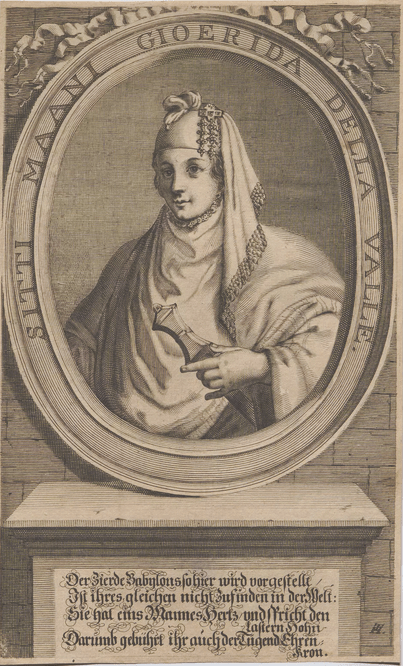
Thomas Hirschmann (Kupferstecher), Sitti Maani Gioerida della Valle, um 1670, Wien Museum Inv.-Nr. W 1212, CC0 (https://sammlung.wienmuseum.at/objekt/307291/)