
Porté par l’université de Huddersfield, en collaboration avec d’autres partenaires académiques (Université Paris Cité, Université d’Utrecht, l’Institut national histoire de l’art à Paris), muséaux (le Victoria & Albert Museum, la Society of Friends Library, le Charleston Trust, The In Flanders’ Fields Museum) et associatif (Archives of Women Artists Research & Exhibitions, AWARE) et avec le soutien de l’Institut universitaire de France, le projet “Threads in Common” vient d’être lauréat, en décembre 2025, d’une bourse collaborative de la Paul Mellon Foundation for British Art, sur la période 2026-2030.
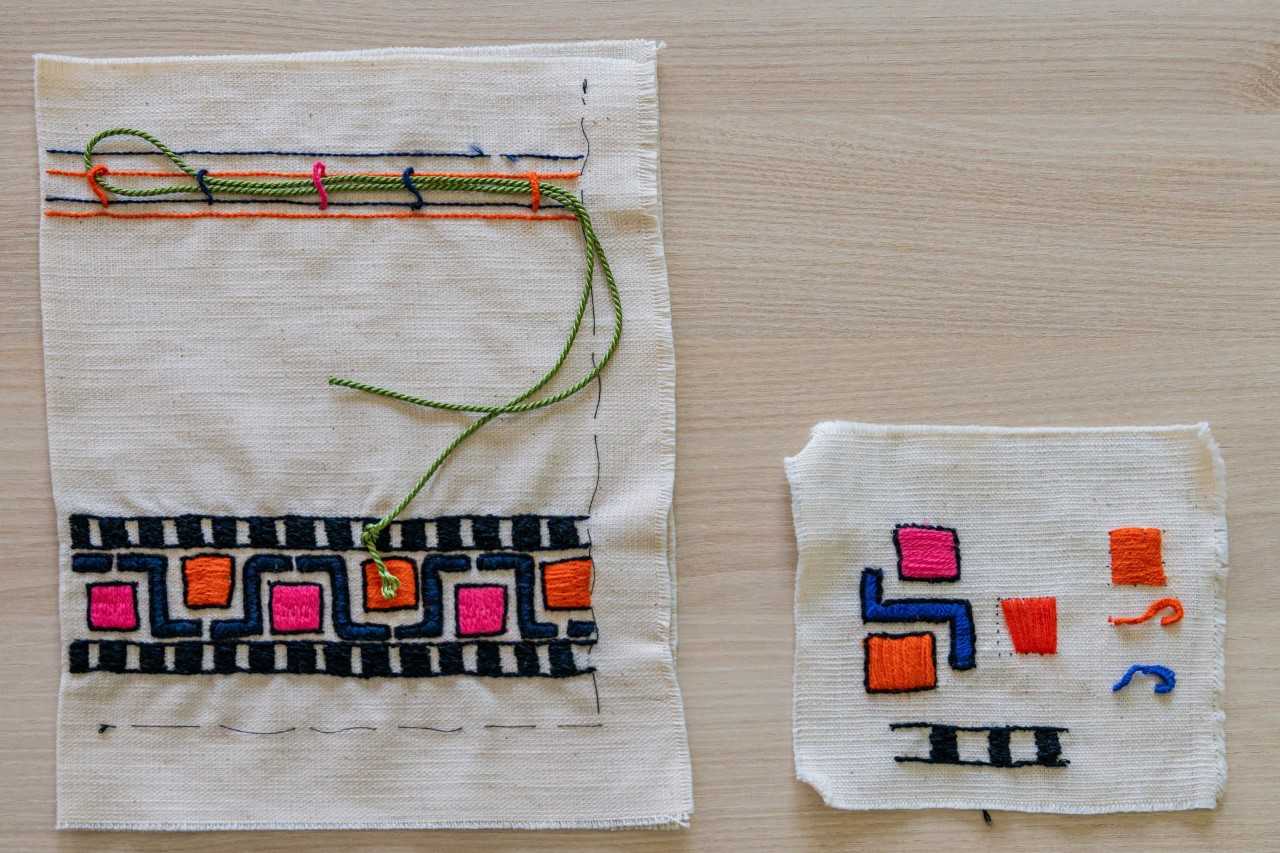
Prototype de pochette de la Coloured Embroidery Industry recréée par Claire Barber et Hannah Marples pour l’atelier “Thinking Through the Surface”, Angers, 12 juin 2025. (Crédit photographique: Olivier Pain).
Prototype of a bag by the Coloured Embroidery Industry, recreated by Dr Claire Barber and historical costumier Hannah Marples for the “Thinking through the Surface” Workshop at Angers on 12.06.2025
Le projet vise à mieux comprendre les ambitions artistiques et politiques du Coloured Embroidery Scheme, un dispositif d’aide humanitaire mis en place par la mission anglaise quaker entre 1916 et 1919, auprès des femmes réfugiées et évacuées dans la Marne et la Meuse de l’arrière-front (en particulier Sermaize-les Bains et Bar-le-Duc). Contrairement à ce qui a longtemps été pensé, le dispositif fut mis en place et géré par des femmes. L’instigatrice était la réformatrice et mathématicienne quaker Sara Margaret Fry, et non son frère et critique d’art Roger – qui avait, par ailleurs, co-fondé les Ateliers Omega (1913-1919), une coopérative d’artistes dédiée principalement aux arts appliqués, avec deux autres membres du « groupe de Bloomsbury », à savoir Vanessa Bell (sœur de Virginia Woolf) et Duncan Grant. L’équipe sera ainsi attentive à sortir de l’ombre ces femmes – quel que fusse leur rôle dans le dispositif (instigatrice, opératrice, brodeuse, vendeuse, mécène, etc.) – afin d’alimenter la réflexion sur « genre et humanitaire », au-delà de la compassion. Par ailleurs, par son ambition radicale de créer une nouvelle harmonie pour le “monde d’après” – tant par sa grammaire visuelle moderniste (formes et coloris), que par son affichage internationaliste –, le Coloured Embroidery Scheme invite l’équipe à repenser les liens entre l’internationalisme visuel et politique des ateliers Omega à Londres pendant la Première Guerre mondiale et l’esthétisme novateur d’un humanitarisme de l’arrière-front, d’autant que le scheme utilisait des fils fournis par les Ateliers Omega.
Dans une série d’ateliers et de conférences, l’équipe fera dialoguer différentes disciplines et optiques (historien.ne.s de l’humanitaire, historien.ne.s de l’art et du textile, conservateur.trice.s du patrimoine, spécialistes de la couleur et artistes/ artisans textiles, etc.) afin de mieux comprendre les enjeux, outils et réseaux variés de cet internationalisme pratique à l’époque, et de réfléchir à leurs enseignements pour le monde contemporain.
Pour Université Paris Cité, ce projet fait suite à l’invitation de Rebecca Gill (U. Huddersfield) en tant que professeure invitée en juin 2025 et à l’organisation d’un premier atelier expérimental en sa présence, et avec les membres fondatrices du projet – Claire Barber (U. Huddersfield), Stéphanie Prévost (U. Paris Cité/IUF/Visiting Fellow U. Huddersfield), et Wendy Wiertz (U. Utretcht) – au colloque d’Angers « Tissage, langage, écriture : penser et pratiquer la recherche création » le 12 juin 2025.
***
The ‘Threads in Common’ project has just been selected for a Paul Mellon Centre Collaborative Grant (2026-2030). The project is led by the University of Huddersfield, with Charleston Trust, Society of Friends Library, Victoria & Albert Museum, The In Flanders’ Fields Museum, Archives of Women Artists Research & Exhibitions (AWARE), Utrecht University, Université Paris Cité, and the Institut National Histoire de l’Art, and with the support of the Institut universitaire de France.
In the First World War, Omega designers, Quakers, and French and Belgian refugee women cooperated in an original, yet relatively neglected experiment in modernist design and embroidery : the Coloured Embroidery’ scheme led by British Quaker and mathematician Margery Fry in the war-torn Marne et Meuse departments between 1916 and 1919. The vibrant pieces, handsewn by French and Belgian displaced women, reveal pioneering modernist geometric designs in vividly-coloured threads sent from the Omega Workshops, a design firm co-founded in London by her brother, the art critic Roger Fry, in 1913.
The project offers an exceptional insight into the forgotten story of how Bloomsbury’s modernist artists intervened directly in the battle-zone of the First World War to create a new visual language of internationalism and spiritual harmony in the face of trauma. It has a number of aims (1) to test assumptions between art and therapeutic solace through confrontation with the soundscapes of WW1 (2) to identify the forgotten role of Omega modernist design and practice in bridging British art and international craft traditions before the Bauhaus opened in Germany in 1919 (3) to disrupt representations of the Bloomsbury circle’s pacifism as insular by integrating the history of the Belgian and French refugee diaspora and Quaker activism (4) to explore the contemporary significance of these avant-garde visual traditions and reflect upon the place of innovative design in refugee enterprises then and now.
To unravel the stakes, tools and networks of this practical internationalist scheme then and now, the project brings together specialists from different disciplines (historians of humanitarianism, art and textile, cultural heritage curators, colour specialists, textile artists and craftspeople, etc.) around a series of practice-based workshops and conferences.
The project’s idea was born during the visiting professorship of Dr Rebecca Gill (U. Huddersfield) at Université Paris Cité in June 2025, and refined during a participatory workshop that she co-organised with the other main project team members – Claire Barber (U. Huddersfield), Stéphanie Prévost (U. Paris Cité/IUF/Visiting Fellow U. Huddersfield) & Wendy Wiertz (U. Utretcht) – at the Angers ‘Weaving, language, writing : thinking and practicing research-creation’ international conference (12 June, 2025).