
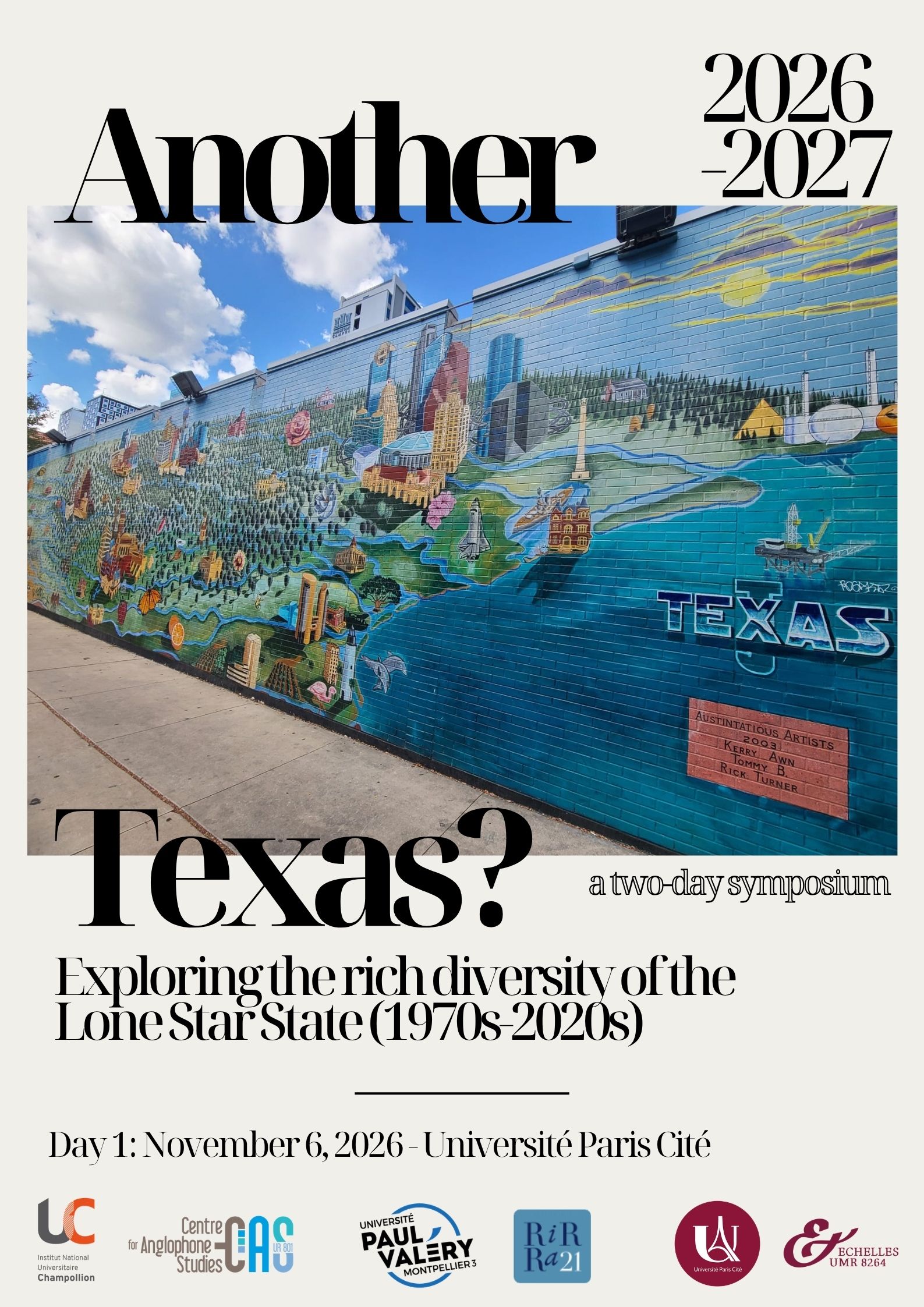
Another Texas?
Exploring the Rich Diversity of the Lone Star State (1970s-2020s)
Day 1: Nov 6, 2026, Université Paris Cité – Room ODG 105 (“Espace ODG”)
Organized by Emilie Cheyroux (INU Champollion, Albi),
Marine Soubeille (Université Paris Cité) and
David Roche (Université de Montpellier Paul-Valéry, Institut Universitaire de France)
November 6th marks the first step of the two-days symposium about Texas diversity, its cultural institutions and representations. This first day will explore a wide variety of representations of the Lone Star State and its main tropes across literature, cinema and television. Welcoming participants from Europe and the United States, the symposium will be organized in 3 thematic panels as well as a keynote, and invite the audience to participate in the rich discussions they might trigger, as well as to question their own imaginary construction of Texas and where it comes from.
Program of the day:
Coffee for all, welcoming participants (8:30)
Panel 1 (9:00-10:30) – What, no westerns y’all? 20th century Texans facing modernity
- Karla Cotteau (Université d’Angers), “What Makes a Short Story Texan?”
- Alix Roger (Université de Lille), “Austin’s Cosmic Cowboy Subculture: Cultural Rewritings of the Texan Cowboy and Alternative Expressions of the Texan Identity after the 1960s”
- Guilhem Billaudel (Université Bretagne Sud), “Major Tom Back to Ground Control – Houston Households as the Antechamber of Space Conquest (Lucy in the Sky [Noah Hawley, 2020] and Apollo 10 1⁄2 [Richard Linklater, 2022])”
Coffee Break (10:30-11:00)
Panel 2 (11:00-12:30) – Forget the lonesome cowboy! Exploring Texas masculinity on screen
- Céline Rolland Nabuco (Université de Bordeaux), “Another view of masculinity in contemporary Texas culture: a new take on the soldier figure in Nancy Schiesari’s documentary films Tattooed Under Fire (2008) and Canine Soldiers (2018)”
- Vincent Jaunas (Université Jean Monnet), « Épuisement des clichés du Texas redneck dans Killer Joe (2007), Boulevard de la Mort (2007) et No Country for Old Men (2011) »
- Josie Garza Medina (University of North Texas), “Homo Texanius: Commingling Counter Visions of White Texas Masculinity in the Films of Eagle Pennell and Richard Linklater”
Lunch Break (12:30-14:00)
Keynote (14:00-15:00) – Amy Wells (Université de Caen Basse Normandie), “‘Steers and Queers’: LGBTQ+ Communities Surviving and Thriving in the Lone Star State”
Another Coffee Break – you love it! (15:00-15:30)
Panel 3 (15:30-16:30): Get a grip, dude… Texas has always been diverse!
- Costanza Salvi (University of Bologna), “Flashback to the Texas-Mexico Border: A Comparison Between Duel in the Sun (1947) and Lone Star (1996)”
- Mikael Toulza (Université de Lille), “An Othered Texas: Rural Black Christianity in Sound of Hope: The Story of Possum Trot (Weigel, 2024)”
Closing words (16:45)
For the full event’s page and CFP for both days: