
Le laboratoire ECHELLES (Axe Savoirs et Axe Imaginaires) et CERILAC (Axe Thélème) vous convie au book launch de l’ouvrage Embodied Epistemology as Rigorous Historical Method (suivi d’un pot) de Lauren Mancia (CUNY), guest professor à Paris Cité, le 31 mars 2026 de 17h30 à 19h (bâtiment Olympe de Gouges – salle 830, Place Paul Ricoeur 75013 Paris)
Le book launch sera suivi d’un workshop participatif mené par Lauren Mancia la semaine suivante le 7 avril 2026 de 17h30 à 19h30 à Paris Cité (bâtiment Olympe de Gouges – salle 830, Place Paul Ricoeur 75013 Paris)
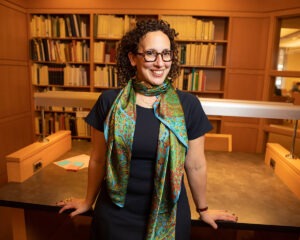
Lauren Mancia is Associate Professor of History at Brooklyn College and of Medieval Studies at CUNY Graduate Center, City University of New York. She is also a staff lecturer at the medieval branch of The Metropolitan Museum of Art, The Met Cloisters. A scholar of 11th and 12th century monastic devotion, she is the author of three books: Emotional Monasticism: Affective Piety at the Eleventh-Century Monastery of John of Fécamp (Manchester University Press, 2019; paper 2021); Meditation and Prayer at the Eleventh- and Twelfth-Century Monastery: Struggling Towards God (ARC Humanities Press, 2023); and Embodied Epistemology as Rigorous Historical Method (Cambridge Elements, 2025). https://www.gc.cuny.edu/people/lauren-mancia
PART 1: Book Launch (31st March 2026)
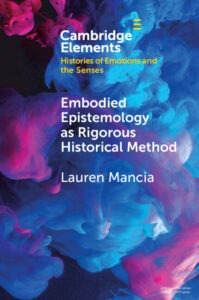 Since Leopold von Ranke, historians have privileged textual sources as the chief way scholars can know history. But is there an equally rigorous extra-textual, embodied method that scholars could use to understand the past? This talk will draw from Mancia’s new Cambridge Element Embodied Epistemology as Rigorous Historical Method. Mancia will engage with the differences between the archive and the repertoire, between the records of historical performances and the performed, embodied movements of the historical event itself by drawing from tools from the discipline of performance studies. She will explain why historians assume they cannot use reperformance in historical inquiry and why they, in fact, should. She will show how an embodied epistemology is particularly suited to studying certain premodern historical topics, such as the subject of her specialization, medieval European monasticism. And finally, using the case of performance-lectures given at The Met Cloisters, she will show how using performance as a tool for historical investigation might work.
PART 2: Workshop – Reperforming the Middle Ages (7th April 2026)
Contact: Emma Bartel (emma.bartel@u-paris.fr)