
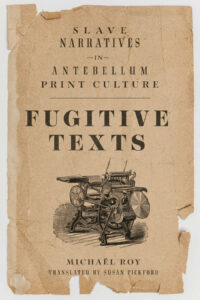
Fugitive Texts
Slave Narratives in Antebellum Print Culture
Présentation | Critiques
Présentation
Antebellum slave narratives have taken pride of place in the U.S. literary canon. Once ignored, disparaged, or simply forgotten, the autobiographical narratives of Frederick Douglass, Harriet Jacobs, and other formerly enslaved people are now widely read and studied. One key aspect of the genre, however, has been left unexamined: its materiality. What did original editions of slave narratives look like? How were these books circulated? Who read them?
In Fugitive Texts, Michaël Roy offers the first book-length study of the slave narrative as a material artifact. Drawing on a wide range of sources, he reconstructs the publication histories of a number of famous and lesser-known narratives, placing them against the changing backdrop of antebellum print culture. Slave narratives, he shows, were produced through a variety of print networks. Remarkably few were published under the full control of white-led antislavery societies; most were self-published and distributed by the authors, while some were issued by commercial publishers who hoped to capitalize on the success of Harriet Beecher Stowe’s Uncle Tom’s Cabin. The material lives of these texts, Roy argues, did not end within the pages. Antebellum slave narratives were “fugitive texts” apt to be embodied in various written, oral, and visual forms.
First published in French, Fugitive Texts illuminates the heterogeneous nature of a genre often described in monolithic terms and ultimately paves the way for a redefinition of the literary form we have come to recognize as “the slave narrative.”
Critiques
Winner of the SAES / AFEA Book Prize
“This evocative study throws into stark relief the material conditions of authors who not only produced texts but also shepherded them through print infrastructures and into the hands of readers. Making contributions to African American literary history, book history, and print culture studies, Fugitive Texts encourages continued conversations about the material conditions of this literary history.” ~Brigitte Fielder, author of Relative Races: Genealogies of Interracial Kinship in Nineteenth-Century America
“Fugitive Texts adds immeasurably to our knowledge of African American writing and publication, and it offers us a new way to think about ‘the slave narrative’ as a genre. . . . Roy’s book is superbly researched and carefully argued, and it makes a unique contribution to African Americanist criticism.” ~Early American Literature
“Ingeniously conceptualized, deeply researched, and forcefully argued. . . . A beautifully written book.” ~Textual Cultures